
MAGICAL MISCELLANY
Friday the 13th: Lunar Mischief, Myth, and the Year of Three

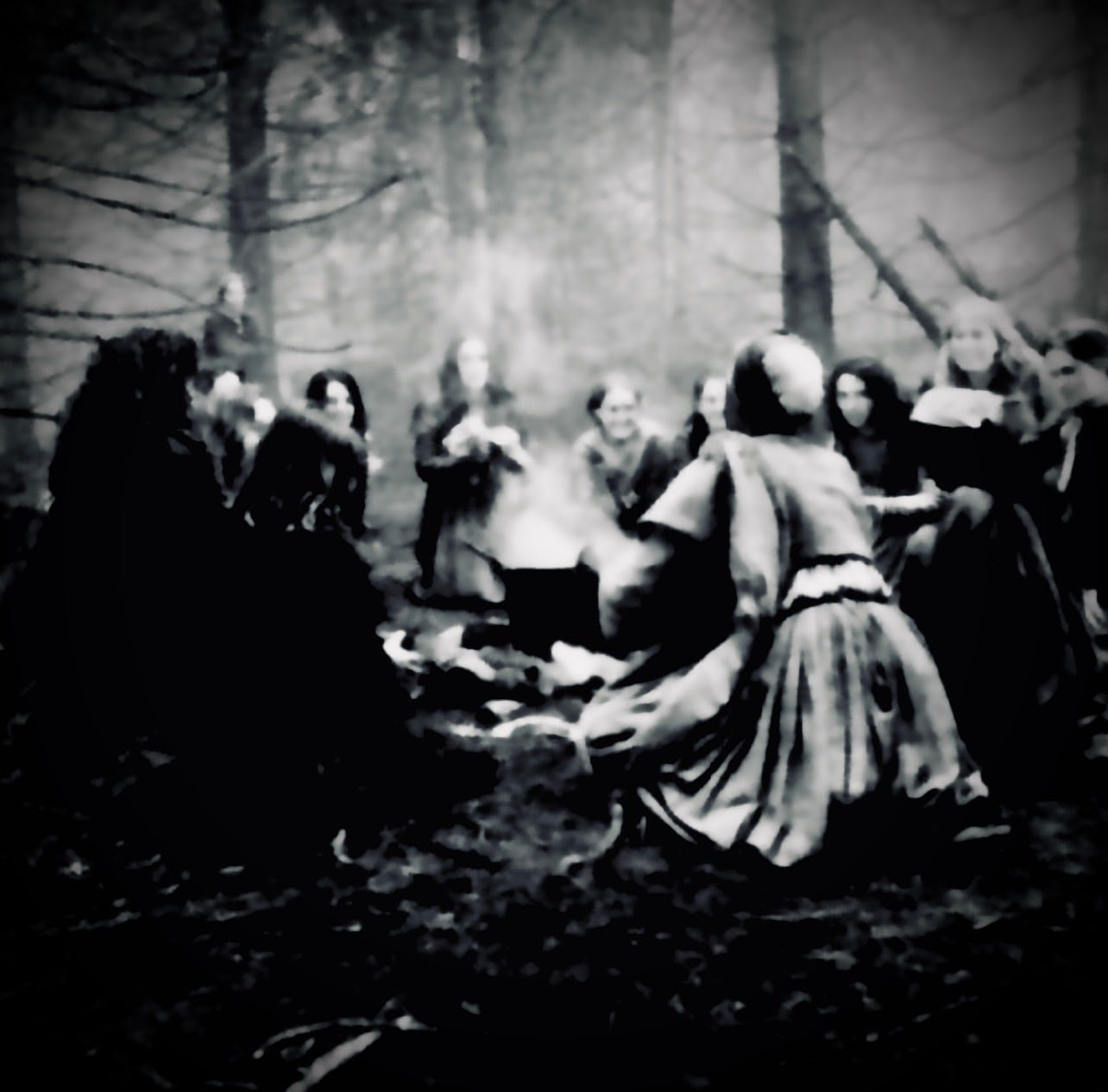
Every time Friday the 13th appears on the calendar, it carries the same basic archetype—but the flavor changes depending on when it arrives…
The symbolism is never static. It bends with the season, the emotional weather of the month, and the cultural stories we have layered onto it. Think of it as the same myth wandering through different landscapes each time it shows up—sometimes crossing a frozen river, sometimes slipping through a garden in bloom, sometimes descending a staircase into the underworld.
At its core, Friday the 13th is the collision of two ancient symbols...
Friday traditionally belongs to Venus, or in Norse myth to the goddess Freya—figures associated with love, fertility, beauty, sensuality, and the unapologetic power of the feminine. The number thirteen carries its own old magic—it corresponds to the thirteen lunar cycles that move through a year, tying it to the rhythms of the moon, to the cycles of life, death, and rebirth, and to initiatory thresholds that rarely ask permission before they rearrange things.
In many early traditions, thirteen was sacred rather than sinister—it was the number of transformation, the number that signals a doorway between phases of existence…
When you combine those two elements, the original symbolism of Friday the 13th looks less like bad luck and more like something wild and alchemical… it is the sacred feminine colliding with the number of transformation. Not a curse, but a catalytic moment—an energetic pocket where the usual rules wobble. The discomfort many cultures later attached to the date says less about the day itself and more about humanity’s long-standing nervousness around forces it cannot neatly control.
What makes Friday the 13th particularly fascinating is that it changes personality depending on which month it falls in. The archetype stays the same, but the seasonal myth surrounding it shifts. Each appearance becomes a different chapter in the same cosmic story.
When it appears in January, the tone is unmistakably one of reckoning… the year has barely cracked open, and the symbolism leans toward truth-telling and recalibration. January’s Friday the 13th behaves like a cosmic audit—clearing illusions, reviewing karmic ledgers, deciding what the year will actually become once the champagne fizz of New Year’s optimism settles down and the real work begins.
February’s version has a softer but far more mischievous edge... February is steeped in the mythology of love, desire, and human attachment—when Friday the 13th lands here, it tends to stir unconventional love stories, relationship revelations, and the kind of emotional honesty that exposes the gap between what the heart secretly wants and what society politely performs.
March carries a completely different atmosphere—it is the threshold month that leans toward the equinox, when winter and spring briefly wrestle over who gets the final word… a March Friday the 13th often signals initiation—crossing into a new identity, shedding the heavy coats of the past season, stepping through a doorway that feels suspiciously like a portal. Symbolically, it resembles a witch standing in the doorway between worlds, deciding which side she intends to walk into.
April brings an entirely different temperament. Spring has fully woken up, and the earth is experimenting with life again. April’s Friday the 13th tends to behave like spring lightning—unexpected growth, disruptive creativity, plans rearranged by forces that have their own ideas about timing. It is chaotic fertility energy, the kind that rearranges gardens overnight.
May’s version leans into the wild feminine even more strongly. With ancient festivals like Beltane echoing through the cultural memory of the month, Friday the 13th in May amplifies passion, sensuality, and creative life force. This is perhaps the most Venusian expression of the day—less ominous, more celebratory, like a bonfire that insists you dance around it whether you planned to or not.
June’s appearance acts more like a mirror—with the summer solstice nearby and daylight stretching toward its annual peak, a June Friday the 13th often illuminates imbalances in relationships and power dynamics. It asks where energy is flowing fairly and where it is not. It is a solar mirror, reflecting the truth of how we exchange attention, affection, and authority.
July raises the temperature… the mythology of heat, sun, and vitality makes this version of Friday the 13th feel like trial by fire. Ego confrontations, bold decisions, and moments of courage tend to dominate its symbolic terrain. It is a day that pushes people toward action—sometimes recklessly, sometimes heroically.
August’s version often carries an undertone of power—positioned near the Lion’s Gate of early August and the slow build toward harvest season, it frequently highlights ambition, leadership tests, and the dynamics of authority. The question that lingers in the air is simple but profound: who holds the throne, and why?
September shifts the story toward accountability… as harvest symbolism takes center stage, Friday the 13th here tends to feel like a balancing of scales. Consequences surface, cycles complete, and the results of earlier actions become impossible to ignore.
October, of course, is where the folklore becomes thick enough to slice with a ceremonial dagger—with the mythology of Samhain and the thinning veil already embedded in the month, a Friday the 13th in October leans deeply into the mystical. Psychic openings, ancestral echoes, and hidden truths have a way of surfacing around this time. It is pure folklore energy—the kind that makes old ghost stories feel oddly plausible.
November’s appearance carries the symbolism of descent… as the natural world begins its slow retreat into winter, a November Friday the 13th tends to involve emotional transformation and shadow work. It is the mythic moment when Persephone steps into the underworld, reminding us that endings are often the beginning of deeper renewal.
December’s version closes the circle. Sitting near the winter solstice, it behaves like a ceremonial ending—letting go of the year’s residue and preparing the ground for rebirth. It is a cosmic reset, a quiet turning of the wheel before the cycle begins again.
Most years include at least one Friday the 13th, but occasionally the calendar offers three. Those years carry a strange feeling of acceleration, as if the symbolic mechanism behind the day has been dialed up a notch. This year, 2026, is one of these rare configurations, presenting three of them: February, March, and November.
This sequence is not random...
February opened the series with the themes of the forbidden heart—truths about relationships, desires, and emotional authenticity...
March follows immediately afterward, placing the archetype in the threshold month, where identities are shifting and initiations unfolding...
The year then waits several months before delivering the third appearance in November, the symbolic descent into the underworld.
Taken together, the pattern resembles a narrative arc: the heart awakens, the self transforms, and the shadow is ultimately confronted…
It is not superstition so much as pattern recognition. A rhythm. A symbolic echo that repeats across time, reminding us that certain energies arrive in clusters.
•
Part of the eerie reputation of Friday the 13th also comes from a dramatic historical moment. On October 13, 1307, King Philip IV of France ordered the sudden arrest of the Knights Templar across his kingdom. The powerful order—wealthy, politically independent, and deeply entangled in the finances of the medieval world—had become both tempting and threatening to the crown. Hundreds of knights were seized at dawn, accused of heresy, idolatry, and secret rituals. Many confessions were extracted under torture. Eventually the order was dismantled, and its last Grand Master, Jacques de Molay, was executed in Paris in 1314.
Legend later claimed that de Molay cursed the king and the pope as the flames rose around him, a dramatic detail that helped cement the mythic atmosphere around the date… but the irony is that the fear surrounding Friday the 13th is surprisingly recent—the superstition only became widespread in the nineteenth and early twentieth centuries, amplified by novels, newspaper stories, and eventually horror films. Before that, the day held far less cultural baggage.
Which leads to one of history’s small cosmic jokes…
The two elements that make up Friday the 13th were originally sacred. Friday belonged to Venus and Freya. Thirteen marked the lunar rhythm that governed life, fertility, and renewal. What later generations learned to fear was once simply a recognition that life moves in cycles—cycles humans do not fully control.
In that sense, Friday the 13th is less a warning than a reminder.
It marks the places where the calendar briefly stops behaving politely, where the clockworks of everyday life reveal a glimpse of its deeper machinery...
Lunar time. Feminine time. Transformational time.
And perhaps that is why the day has survived every attempt to tame it… even now, centuries later, it still carries the faint feeling that something old and untamed is wandering through the modern world—laughing softly at our attempts to pretend the universe runs on a tidy schedule.
There is another layer to this story that makes Friday the 13th even stranger—and perhaps even more poetic… beneath the folklore, beneath the horror movies, beneath the nervous laughter people give when the date appears on a calendar, there is actually a quiet mathematical pattern hiding in plain sight…
Years that contain three Friday the 13ths are not random accidents of the calendar—they occur when the structure of the year itself falls into a particular alignment… in common years that begin on a Thursday, or leap years that begin on a Sunday, the calendar naturally produces three months in which the 13th lands on a Friday—the rhythm of the calendar wheel simply clicks into place that way.
What is fascinating is that this pattern repeats in cycles—roughly following an 11–6–11–6–11 year rhythm, part of the broader 28-year solar calendar cycle in which the arrangement of weekdays eventually returns to its starting configuration… in other words, the calendar itself periodically generates clusters of Friday’s on the 13th. Certain years carry more of them not because anything supernatural is happening, but because the mathematics of time occasionally leans in that direction.
Yet symbolically, those clusters often feel like pressure points in the timeline… one appearance might pass unnoticed, two might raise an eyebrow—but three in a single year has a way of making people pause, as if the myth behind the date has knocked on the door repeatedly until someone opens it.
Again, this year, 2026, is one of those years.
Even symbolically, that sequence reads almost like a mythic storyline... February opened the pattern with the themes of the heart: love, desire, relationship revelations, and the quiet honesty that emerges when emotions refuse to remain polite.
March follows immediately, placing the archetype at the threshold of the equinox—an initiation moment where identities shift and the old winter self begins to dissolve... then the story will disappear for several months before returning in November, the traditional month of descent, when myths often lead their protagonists into the underworld to confront what has been hidden.
Seen through that lens, the pattern of 2026 almost resembles a ritual sequence: the heart awakens, the self transforms, and the shadow is finally met.
There is also a deeper historical echo behind the number thirteen itself. Long before the Gregorian calendar standardized the modern twelve-month year, many ancient cultures organized time according to the cycles of the moon—a solar year contains roughly thirteen full lunar cycles, and some early calendars acknowledged this by structuring the year into thirteen lunar months rather than twelve solar ones.
In that older worldview, thirteen was not an unlucky number at all. It represented the full natural rhythm of time—the breathing pattern of the moon, the agricultural cycle of planting and harvest, the repeating dance of growth, death, and renewal that governed life long before clocks and spreadsheets attempted to domesticate it.
Only later, as solar calendars became dominant and many lunar traditions were displaced or suppressed, did the number thirteen begin to acquire a darker reputation… what had once symbolized natural completeness gradually became associated with disruption, excess, or something that refused to stay inside the orderly structure of twelve.
In that sense, Friday the 13th may be the ghost of the old lunar calendar still wandering through our modern one.
The psychology surrounding the date adds yet another curious twist...
There is even a clinical term for the fear of it: paraskevidekatriaphobia, a name that sounds like something invented by a linguist with a sense of humor but which genuinely describes the anxiety some people feel about the day.
Paraskevidekatriaphobia is pronounced:
pair-uh-SKEV-ee-day-kuh-TREE-uh-FOH-bee-uh
So it literally means “fear of Friday the 13th.”
It’s one of those words that almost sounds like a playful incantation—fitting for a superstition about a supposedly cursed day…
Studies have found that when Friday the 13th arrives, some individuals avoid travel, postpone financial decisions, or behave more cautiously than usual. Ironically, this heightened caution can sometimes reduce accidents or risky behavior—the superstition itself subtly changes human actions, which in turn changes the outcomes people experience.
In other words, the day does not cause the disturbance—the human imagination does.
One final symbolic thread ties many of these ideas together... in mythological and symbolic systems across cultures, twelve often represents order and completion—there are twelve months in the solar year, twelve signs of the zodiac, twelve Olympian gods, twelve hours on the clock face that repeats endlessly.
Thirteen is what comes next.
It is the moment after completion—the number that steps outside the circle and asks what lies beyond it. Because of that, thirteen frequently becomes associated with transformation, rebellion, initiation, and the outsider—the figure who crosses boundaries others prefer to keep intact.
It is not the number of the finished system—it is the number that breaks the system open…
Which may explain why witches, covens, and other figures of folklore became symbolically linked with the number thirteen across European traditions... a traditional coven was often imagined to contain thirteen members—not because of misfortune, but because thirteen represented the threshold where ordinary rules gave way to deeper knowledge. The circle of twelve plus the one who carries the spark of transformation.
Seen through that lens, Friday the 13th begins to look very different from the unlucky day popular culture likes to imagine—it resembles something older and far more interesting: a small wrinkle in the calendar where lunar rhythms, mythic symbolism, and human imagination briefly overlap…
A moment when time itself seems to lean sideways and whisper that the universe has always been a little stranger than our schedules suggest.
•
One of the oldest threads involves the goddess Freya, whose name gives Friday its origin in the Norse languages...
Freya was not simply a goddess of love in the soft, perfumed sense—Freya ruled over passion, fertility, beauty, sorcery, and war. In Norse myth she possessed the magical practice known as seiðr, a form of prophecy and spellcraft that later cultures would associate with witchcraft. When Christianity spread across Northern Europe, many practices connected to Freya and other goddess traditions were recast as dangerous or sinful. Over time, Friday—the day originally associated with her—was gradually transformed in folklore from a day of feminine power into a day tinged with suspicion. Seen through that lens, Friday the 13th may partly reflect the cultural memory of a goddess whose influence was never entirely erased, only reframed.
Another symbolic strand appears in medieval Christian imagery surrounding the Last Supper. According to tradition, thirteen people sat at the table that night, with Judas—the betrayer—counted as the thirteenth guest. This detail helped reinforce the suspicion surrounding the number… yet the symbolism of thirteen at a table actually existed long before the Christian story—in many older traditions, inviting thirteen to a feast was believed to introduce the unexpected guest—the figure who changes the fate of everyone present... the myth of Judas may have simply inherited that older archetype: the thirteenth presence who alters the entire story.
There is also an intriguing cultural echo surrounding the gallows and the number thirteen—in some medieval European traditions, it was said that a full set of gallows ropes could accommodate twelve prisoners while the thirteenth rope hung unused, reserved for the one whose crime had not yet been committed. Whether or not this practice was widespread, the story circulated widely enough to reinforce the idea that thirteen marked the moment when the established order tipped into something darker and more unpredictable.
Yet folklore also preserved the opposite idea: that thirteen could represent a circle of power rather than misfortune…
In many stories about witchcraft and folk magic, a coven was imagined to consist of thirteen members. The symbolism is striking—twelve figures forming the circle of order, with the thirteenth representing the catalyst that activates it… the number did not signify chaos alone—it represented the spark that made transformation possible.
All of these traditions—Norse mythology, medieval Christian symbolism, folk magic, lunar calendars, and historical events like the downfall of the Knights Templar—slowly braided themselves together across centuries. None of them individually created the superstition surrounding Friday the 13th... instead, the reputation of the date emerged from the accumulation of stories, each adding another brushstroke to the mythology.
This may explain why the day continues to fascinate people even now... it carries echoes of goddess traditions, medieval politics, lunar rhythms, and human imagination all tangled together in a single square on the calendar.
In the end, Friday the 13th may not be unlucky at all… it may simply be one of those rare moments when the ordinary clock of modern life briefly reveals the older machinery beneath it—the myths, cycles, and symbols that have been quietly shaping human stories for thousands of years.